By Dr. Adarsh Gupta, DO, MS | Board Certified Physician · Author, The Science of Habits · ValleyForgeWMC-Habit Intelligence System.
If you have tried more than one weight loss program without lasting results, there is something important you need to hear first: you have not failed the plan. The plan failed to understand you.
Research published in Current Nutrition Reports confirms that around half of individuals regain lost weight within two years of completing a weight-loss program — and that the failure rate is not primarily due to lack of effort or motivation. Factors contributing to the failure of weight loss programs include the impracticality of restrictive diets, limited focus on lifestyle changes, and psychological influences — none of which are addressed by simply eating less and moving more.
Understanding why most weight loss plans fail is the first step toward choosing an approach that actually works. And increasingly, that approach is habit coaching — specifically, a structured system that identifies and closes the behavioral gaps that diets cannot reach.
The 6 Reasons Why Most Weight Loss Plans Fail
1. They Target the Symptom, Not the Cause
The most fundamental problem with conventional weight-loss programs is that they treat weight as the problem when it is actually the result. The causes — the specific behavioral patterns around food, activity, stress, and sleep that drive weight gain — are rarely addressed directly.
Long-term outcomes depend primarily on adherence to and consistent implementation of recommendations, and behavioral and psychological factors such as emotional eating, dietary fatigue, and unrealistic expectations often contribute to weight regain.
In other words, the plan may be technically correct. But if it does not account for your behavioral patterns, it will eventually fail to account for your biology.
The plan may be technically correct. But if it does not account for your behavioral patterns, it will eventually fail to account for your biology.
What habit coaching does instead: The Habit Intelligence System™ (HIS Score™) measures your actual behavioral patterns across four domains — Nutrition, Movement, Mindset, and Sleep — before any coaching begins. You cannot fix what you have not measured.
2. They Are Generic When Results Require Personalization
A diet that works for one person may be actively counterproductive for another. Your stress patterns, sleep quality, work schedule, emotional relationship with food, and movement history are all unique to you. A generic plan ignores every one of these variables.
The research is consistent: successful weight loss and maintenance is associated with active lifestyle habits, self-monitoring of weight-related behaviors, regular food intake patterns, and control over eating behavior — all of which must be built around the individual’s actual life, not a template.
What habit coaching does instead: Your HIS Score™ identifies your personal lowest-scoring habit domain — the specific area where a small, targeted intervention produces the greatest compound return. No two coaching plans look the same because no two HIS Score profiles are identical.
3. They Rely on Willpower Instead of Systems
Willpower is finite, stress-depleted, and chronically overestimated as a weight management tool. Most conventional programs assume that motivation is enough to override years of established behavioral patterns. It is not.
A 2024 systematic review showed that health-related habits can take two to five months to develop — and many experts recommend a gradual, steady approach because it makes habits more sustainable and reduces stress on the body.
The implication is significant: the goal of weight management is not to muster more willpower. It is to build habits so automatic that they no longer require willpower at all.
What habit coaching does instead: The HIS framework builds behavioral systems — not motivational strategies. Each habit is anchored to an existing daily routine, making it progressively more automatic and less dependent on energy or intention.
4. They Ignore the Behavioral and Emotional Layer
Food is not just fuel. For most people, eating is deeply connected to stress, boredom, celebration, social pressure, and emotional regulation. A meal plan addresses none of this. Neither does a calorie counter.
For most people, eating is deeply connected to stress, boredom, celebration, social pressure, and emotional regulation. A meal plan addresses none of this. Neither does a calorie counter.
Weight will be regained if the individual returns to their previous dietary and physical activity habits — and many weight loss strategies only change behavior in the short term. Techniques involving strict restraint can be unsustainable for weight maintenance.
The Mindset domain of the HIS Score™ captures exactly this — the behavioral and emotional habit patterns that determine whether a person can sustain change when life is difficult, stressful, or unpredictable.
What habit coaching does instead: Mindset is scored as a distinct domain in the HIS framework. If your Mindset score is your weakest domain, coaching starts there — with behavioral tools for managing emotional eating, stress responses, and the decision fatigue that drives most unplanned eating.
5. They Have No Measurement System for the Real Problem
Most weight loss programs measure one thing: weight. But weight is a lagging indicator. It tells you what happened weeks ago. It does not tell you which specific habit broke down, which domain is weakest, or what to change.
Successful weight losers were significantly more likely to track multiple behaviors — including physical activity, meal planning, and self-monitoring — than those who were unsuccessful at weight maintenance.
The difference is in measurement. Not of calories or pounds, but of the behavioral patterns themselves.
What habit coaching does instead: The HIS Score™ produces a 0–100 score across all four domains — Nutrition, Movement, Mindset, and Sleep. Every 30 days, scores are rechecked. You can see exactly which domains have improved, which need more attention, and where your coaching energy is best directed. Progress becomes visible, specific, and motivating.
6. They End — But the Habits Haven’t Been Built Yet
Most diet programs have a defined duration — 12 weeks, 30 days, or a season. When the program ends, participants are returned to the same environment, the same stressors, and the same behavioral patterns that caused the problem in the first place. Without new habits firmly in place, regain is nearly inevitable.
Around half of individuals regain lost weight within two years — and a holistic approach considering lifestyle modifications and behavioral strategies is crucial for safe and sustainable weight management.
What habit coaching does instead: The 90-day HIS coaching program is specifically designed around the behavioral automaticity timeline — the period during which habits move from effortful choices to background operating patterns. By the end of the program, the goal is not to have followed a plan for 90 days. The goal is to have habits that now run without the plan.
The Habit Intelligence System™: A Different Starting Point
The HIS Score™ was designed by Dr. Adarsh Gupta specifically to address every one of the failure modes above. It does not start with a meal plan or a calorie target. It starts with a question: where is your habit foundation weakest right now?
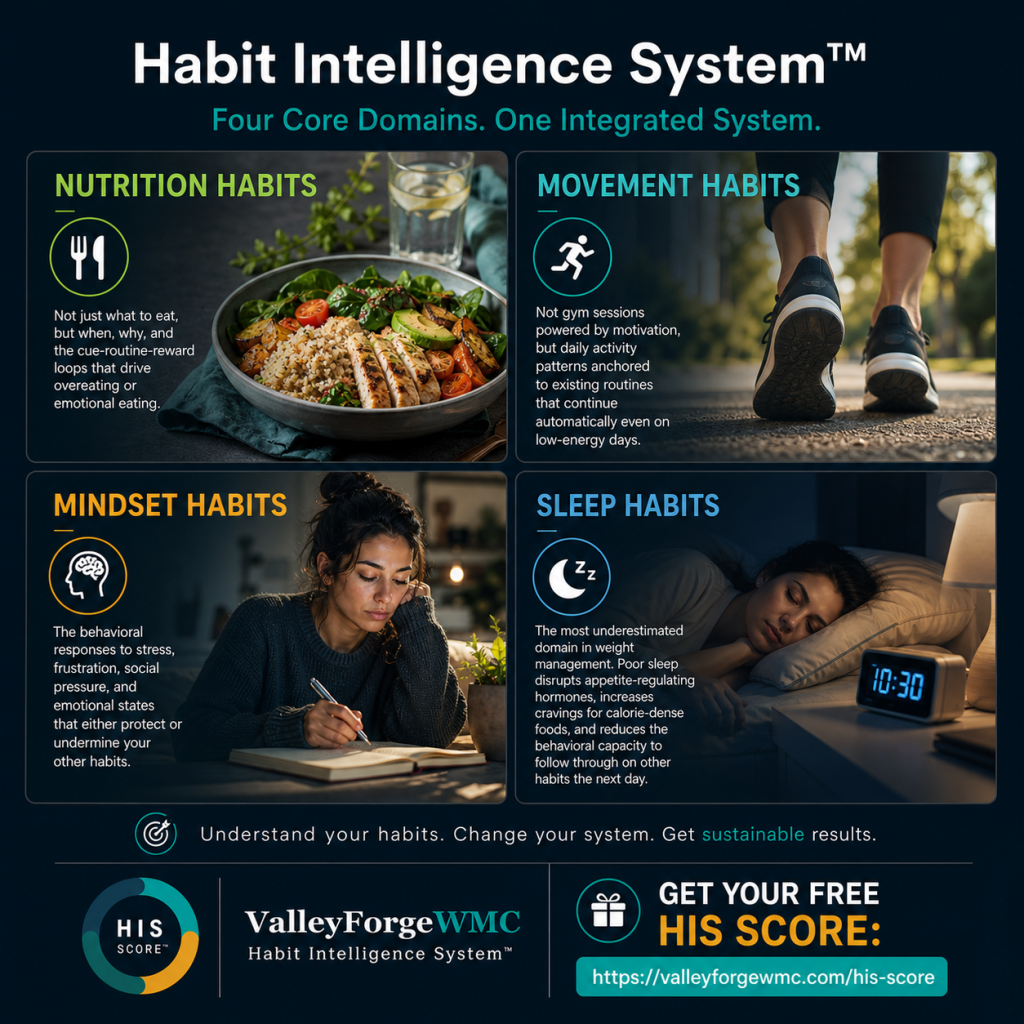
The free three-minute assessment measures four domains:
🥗 Nutrition Habits — not just what you eat, but the behavioral patterns around when, why, and how you eat.
🏃 Movement & Activity — not gym motivation, but the daily movement habits that continue automatically even on difficult days.
🧠 Mindset & Behavior — the emotional and psychological habit patterns that either protect or undermine your other domains under stress.
😴 Sleep & Recovery — the most underestimated driver of appetite, cravings, and behavioral capacity for change.
Each domain is scored 0–100. Your lowest-scoring domain is your coaching priority — the highest-leverage starting point for the fastest, most compounding results.
The 6 Things Habit Coaching Does Differently
| What Most Plans Do | What HIS Habit Coaching Does |
|---|---|
| Gives you a template | Measures your actual habits first |
| Treats everyone the same | Starts with your personal HIS Score™ |
| Relies on your willpower | Builds behavioral systems that run automatically |
| Focuses only on food | Addresses all 4 habit domains |
| Measures weight | Measures the behaviors that determine weight |
| Ends after the program | Builds habits designed to outlast coaching |
Frequently Asked Questions
Why do most people regain weight after losing it?
The most common reason is that the behaviors that caused weight gain were paused, not changed. When a restrictive program ends, old habits reassert themselves. Lasting weight management requires that new habits become automatic — a process that research shows takes two to five months of consistent practice, not two to four weeks of a diet.
Is habit coaching better than a diet program?
They address fundamentally different things. A diet program specifies what to eat. Habit coaching identifies and changes the behavioral patterns that determine whether you actually follow through — and for how long. For people who have tried diets without lasting success, the problem is almost always behavioral, not informational. Habit coaching addresses the root cause.
What is the HIS Score™ and how does it help?
The HIS Score™ (Habit Intelligence System™) is a free, physician-designed assessment that measures your habits across Nutrition, Movement, Mindset, and Sleep — giving you a 0–100 score for each domain. It identifies your highest-leverage coaching priority: the single domain where focused effort produces the fastest compound results. You can take it free in three minutes at valleyforgewmc.com/his-score.
Does habit coaching work for people on GLP-1 medications like Ozempic or Wegovy?
Yes — and it is one of the most important times to use it. GLP-1 medications change appetite physiology. They do not build habits. When the medication ends, appetite regulation shifts back — and without habits firmly in place, weight regain follows. Habit coaching builds the behavioral foundation that makes GLP-1 results last. The GLP-1 Habit Protocol is designed specifically for all three stages: considering medication, currently taking it, or recently stopped.
Is this a medical program?
No. ValleyForge WMC provides strictly non-medical lifestyle and habit coaching. No prescriptions, no medications, no medical advice. Dr. Gupta’s clinical background informs the program design — the coaching is personalized, behavioral, and built around your real life.
Your Starting Point: The Free HIS Score™
If you have tried weight loss programs before and struggled to make results last, the most useful thing you can do right now is get an honest picture of where your habit foundation actually stands.
The free HIS Score™ assessment takes three minutes. It measures your habits across all four domains and tells you — specifically — which one to focus on first for the fastest, most sustainable results.
Most people say it is the first time they have had a clear, data-based answer to a question they have been asking for years: why does this keep happening?
No credit card. No obligation. Just a physician-designed habit assessment that gives you a genuinely useful starting point — for free.
This article is for educational and informational purposes only and does not constitute medical advice, diagnosis, or treatment. ValleyForgeWMC-Habit Intelligence System provides non-medical lifestyle and habit coaching only. Consult your physician for medical concerns.
About the Author: Dr. Adarsh Gupta, DO, MS is a Board Certified Physician, author of The Science of Habits, and founder of ValleyForgeWMC – Habit Intelligence System. With 25+ years of clinical experience and 100+ peer-reviewed publications, he developed the Habit Intelligence System™ to give people a precise, evidence-informed path to sustainable lifestyle change.